
Get Started
If you found this site, you’re already thinking about kids + AI in the right way
A few months ago, my kids were bored at the park. I challenged them to create a play. They gave me the plot, the characters, all the details. Then, I used AI to turn their imagination into "Austin and the Giant Kraken." Austin starred as himself building a sandcastle and Jackson was a friendly sea monster.
They acted it out, had the best time, and then continued performing even after the AI script was done.
That moment changed how I think about AI and kids usage. It’s why I created the
Idea → AI → Play™ framework.

Most parents don’t know where to start with AI
Kids are finding AI tools like ChatGPT and Gemini on their own, using them as shortcuts — copy the answer, skip the thinking, let the tool do the work. Most parents either panic about that or assume kids will figure it out. Both responses miss the point.
The answer isn't avoidance. It's not unlimited access either. It's teaching kids to be the ones in charge.
We have to teach kids intentional use of AI. They need to know how to direct it (and not be directed by it).
The Framework
Every activity on this site runs on the same sequence:
Idea → AI → Play™
Your kid's idea comes first. Full stop. And not a one-sentence “I want a…” idea. A deep idea, something they built or created that they want to do more with. AI is in the middle. It helps execute the idea, not generate it. Play is at the end. We come back off the screen and bring it into real life.
That order is everything. A kid who types "make me a story" gets a story that belongs to no one. A kid who comes with a specific idea and uses AI to build it out ends up with something they can explain, defend, and be proud of. The difference between those two experiences is what this site is about.
Who this site is for
Parents of kids roughly 5 to 14 who want to use AI intentionally at home. You don't need to be an expert in the tech (Not many are. It’s moving so fast).
You just need a creative kid and some curiosity.
The four guiding principles your kids need to understand (And you, too!)
01
AI makes mistakes. And we learn from questioning outputs.
AI will say things with total confidence that are completely wrong. It will fill in gaps, make things up, and tell your kid what it thinks they want to hear. The habit of reading critically and pushing back is not optional. It's the whole skill.
02
Imagination and ideas (from the human) need to come first. Kids lead, AI follows.
Before your kid opens a laptop, they need something to say. A specific character, a real question, an actual vision. The quality of what AI produces is a direct reflection of the quality of the idea that came before it.
03
AI is a tool. It is trained on data and processes information really fast.
Think of it like a very fast librarian who has read everything, but didn't write any of it and doesn't actually understand it the way your kid does. It can retrieve, remix, and generate. It cannot imagine, feel, or care.
04
The AI output is not the finish line. Bring it into the real world.
A story that gets acted out. A recipe that gets cooked. A game that gets played. Whatever AI helps build should leave the screen. That's when it becomes theirs. That's when it sticks.
Where to start
Try one activity. Pick whatever matches what your kid is into right now:
Plot to Podcast — for kids who love stories and characters
Character to Costume — for kids who love dress-up and pretend play
Creation to Coloring — for kids who like to draw or make things
Picks to Plates — for kids with strong opinions about food (all of them)
Dig Site to Discovery — for kids who love digging into a topic
Vision to Video Game — for older kids who want to build something ambitious
"Don't have hours to spare? Good, because you don't need them."
Your kid does the creative work independently. Your job is the 5-10 minutes in the middle where you sit down together and bring their idea into AI. That's it. The before and after belong entirely to them.
KIDS → Create independently
PARENTS + KIDS → AI interaction (5-10 min)
KIDS→ Back to creating independently
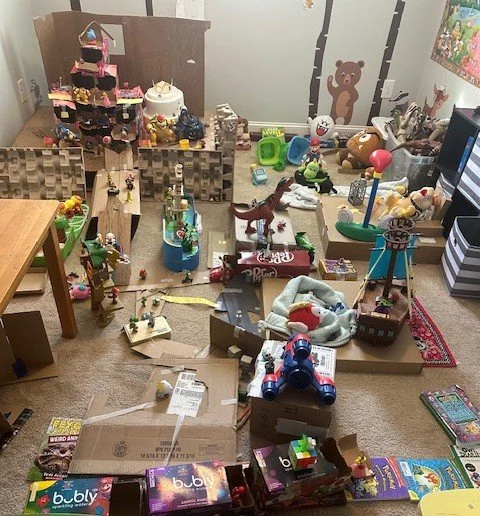
Actual start of the Vision to Video game activity
Keep going
Explore more on the framework, fears, opportunities, what this actually looks like in practice, and other AI topics parents are talking about.
The #1 Rule for AI Use in My House — the one constraint that changes everything about how kids use AI creatively.
For Kids and Young Adults, There's No Do-Over on AI — why the cheating conversation gave kids the wrong frame, and why the window to build good habits is right now.
The "Cheating" Narrative Is Teaching Kids the Wrong Lesson About AI — the fear most parents arrive with, and why reframing it changes everything.
And if you want a structured starting point — the exact questions to ask, activities to run in order, and a framework for talking about AI at home, sign up to receive the free starter guide.