Vision to Video Game
Turn your child's original idea into a playable browser game
How a cardboard world inspired a video game
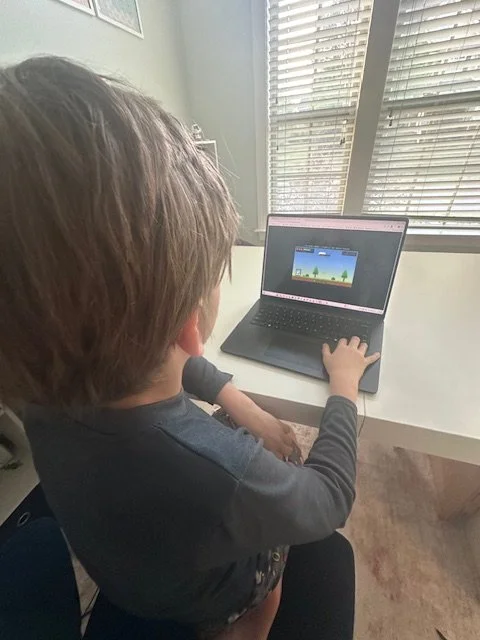
Jackson had spent spring break building a Super Mario World in his room out of cardboard, packaging boxes, blankets, old toys, anything else he could find. There were no instructions, just a vision in his head and a lot of tape. When he finished, he said he wanted to turn it into a video game.
So we said yes, but… He couldn't make a Super Mario game. It had to be his own.
What I expected: He'd tweak the concept slightly, we'd describe it to AI, and we'd have a playable game in an hour.
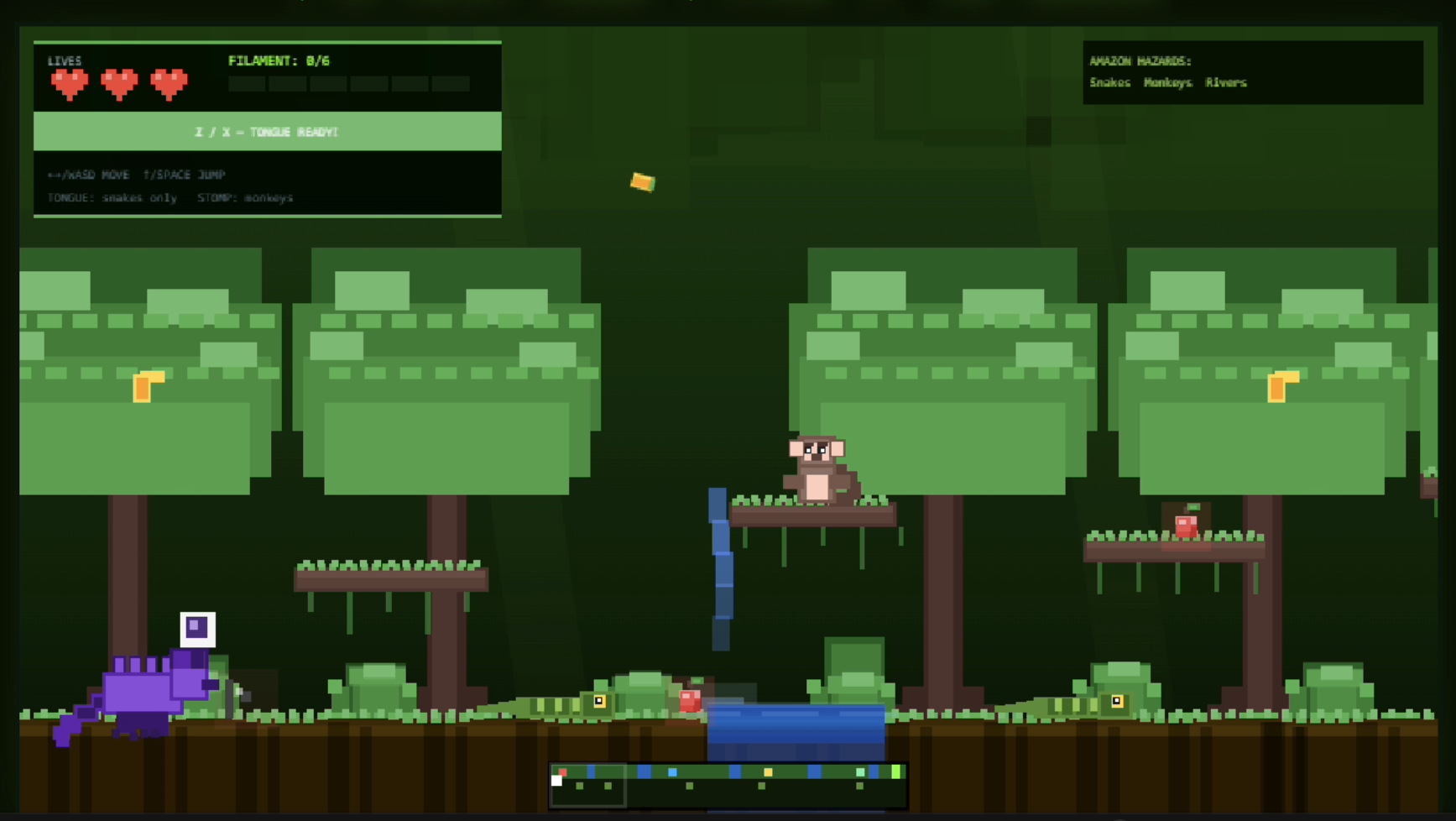
What actually happened: He went to his room with paper and came back with storyboards. A completely original game — a 3D-printed snake who collects filament scattered across the world, brings it back to the 3D printer, and evolves: baby snake → bunny → chameleon → hedgehog → T-Rex. Enemies are 3D-printed foxes and velociraptors. You stomp them like Mario. Loosely inspired by Pikmin. He's 8. He came up with all of it himself.
The activity run-down
What You'll Need
- Paper and something to draw with (storyboards come first, before any screens)
- Claude (claude.ai) to build the game
- A browser to play the finished game
- 1 to 3 sessions depending on how complex the game becomes
Claude has a free plan, but extra usage cannot be purchased on it. For a project like this, which involves multiple back-and-forth prompts across sessions, you will likely hit the daily limit. Claude Pro is $20 per month and removes that barrier.
How to Facilitate the Activity
The Idea - no screens yet
Start here, and do not rush it. Before anything opens, your kid needs to be able to answer these questions out loud. Their answers are the foundation of the entire game.
- ?What is the objective? What is the player trying to do, and what does winning look like?
- ?Who is the main character? Not a character from an existing game. Who does this character become when it is entirely theirs?
- ?What are the enemies or obstacles? What is trying to stop the player, and how does the player defeat them?
- ?What does Stage 1 look like? The setting, the hazards, how you complete it.
- ?Is there an evolution, upgrade, or progression? What changes as the player gets further?
The Brief - still no screens
Once the idea is specific enough to explain clearly, help them write a short brief. It does not need to be formal. A few sentences per element is enough. The more specific it is, the better AI can execute it.
Every detail in that brief came from the kid, not from an existing game. That is the whole point.
Build It with AI
Open Claude and share the brief. Tell it you want a playable browser-based game built from your kid's concept. Include style preferences if they have them (8-bit, cartoon, realistic) and any specific mechanics they described.
It will take a few minutes to build. In some cases, your kid will be able to watch AI going through its thought process in real time. When that happens, narrate it for them: AI is writing the actual code that makes the game run. This is where most adults could not do it faster themselves. AI is handling the entire technical build so your kid can stay focused on being the creative director.
Play It and Iterate
This is where your kid becomes a game tester. Step back and let them play. Their job now is to find everything the brief did not cover, and there will be plenty.
Most kids discover the gaps in their own thinking the moment they start playing. Things that made perfect sense on paper do not always translate into the game the way they imagined. Some mechanics will feel too easy. Others will feel impossible. Rules that seemed obvious turn out to be missing entirely.
- ?What happens if an enemy hits you? How many hits can you take before you have to start over?
- ?How many lives do you have?
- ?Is the game too hard or too easy? Does the difficulty feel right?
- ?Did the setting look the way you pictured it?
- ?What would make Stage 2 different from Stage 1?
Why this demonstrates Idea → AI → Play™
IDEA (kids lead)
Before any screen opens, your kid has to be able to answer: What does the player do? Who is the main character. And it can't be from an existing game. It can be inspired by (because many ideas come from something else).
What are the enemies? What does Stage 1 look like? How does the game end? Jackson went to his room with paper and came back with answers to all of it. That pre-work is non-negotiable.
AI (tool in the middle)
Once the idea is specific enough to explain, it goes to AI as a brief. AI builds the playable game — the code, the mechanics, the art — from your kid's description. They're the creative director. AI is executing their vision.
PLAY (bring it to life)
The finished game runs in the browser. Your kid plays what they built. The gap between what they imagined and what got made isn't a failure, it's the starting point for the next round of feedback. That iteration is where the real learning happens.
The teaching moments
-
Jackson wanted to make Super Mario World, but the rule is it has to be an original idea. This forced decisions he would have otherwise outsourced to Nintendo. Every element of his game came from him.
-
The initial game AI builds will be close, but not quite right. This is perfect. Kids learn to look at something and name specifically what's wrong and come up with the fix: Articulating that gap is a real skill, coming up with the solution is an enhancement of that.
-
The idea is theirs. AI just helps execute where their technical skills end before their idea. If there is something wrong with the output, they need to revisit the idea or the instructions. They own this, not AI.
-
Vague descriptions produce vague games. Kids learn quickly that "make it better" doesn't work, but "make the enemies move faster and appear from the left side" does. Specificity gets results.
Why this activity will help them in the future
We're preparing kids for a world where AI collaboration will be normal. The kids who thrive won't be the ones who know how to use AI tools — those will be everywhere. They'll be the ones who can come to AI with a specific idea, evaluate what comes back, push back when it's wrong, and own the result. This activity is the simplest version of that skill. They practice it by making a game.